

North America
Mexico
Mexico City and Teotihuacán, Oaxaca, the Maya cities of the Yucatán, cenotes and the Caribbean.
- Mexico City & Teotihuacán
- Oaxaca
- Chiapas (Palenque)
- Chichén Itzá
- Cenotes
- Tulum & the Riviera Maya
Mexico is a feast of a country — ancient and modern, mountain and jungle and coast, with some of the best food on the planet. Begin in vibrant Mexico City, ringed by the pyramids of Teotihuacán and the canals of Xochimilco. Eat your way through Oaxaca, the country's culinary heart, beneath the Zapotec ruins of Monte Albán. Dive into the highlands and jungle of Chiapas — colourful San Cristóbal, the canyon of the Sumidero and the Maya temples of Palenque. Then reach the Yucatán: the great pyramids of Chichén Itzá and Uxmal, jewel-like cenotes hidden in the jungle, and the Caribbean coast of Tulum and the Riviera Maya. Warm people, deep history and tacos at every turn tie it all together.
Build your trip
Tune it to you, then export it.
Length
Travel style
Your interests
The essentials: Mexico City and Teotihuacán, then the Yucatán's Chichén Itzá, cenotes and the Caribbean coast at Tulum.
Daily budget:≈ €40–90 / day
Comfortable hotels and boutique stays, restaurant meals, internal flights, guides and cenote and reef trips.
Day by day
- 1

The Metropolitan Cathedral on the Zócalo.© José Luiz · CC BY-SA 4.0 Getting there: Fly into Mexico City (MEX/NLU); transfer to your hotel
Arrive in Mexico City, the vast, vibrant, high-altitude capital. Ease in around the Zócalo — one of the largest squares in the world — with the great Metropolitan Cathedral and the National Palace and its Diego Rivera murals, then settle into leafy Roma or Condesa for your first taste of the city's legendary food scene.
Mexico City surprises everyone — a sophisticated, creative, endlessly energetic metropolis of grand plazas, world-class museums, leafy neighbourhoods and food that runs from street-corner tacos to some of the best restaurants on earth. It's a capital that takes a few hours to win you over completely.
Our take
Stay in Roma, Condesa or Coyoacán for walkable, leafy charm, or the Centro to be among the monuments. The altitude (2,240 m) can leave you a little breathless on day one — take it easy.
Highlights
- ✦ The Zócalo
- ✦ Metropolitan Cathedral
- 2
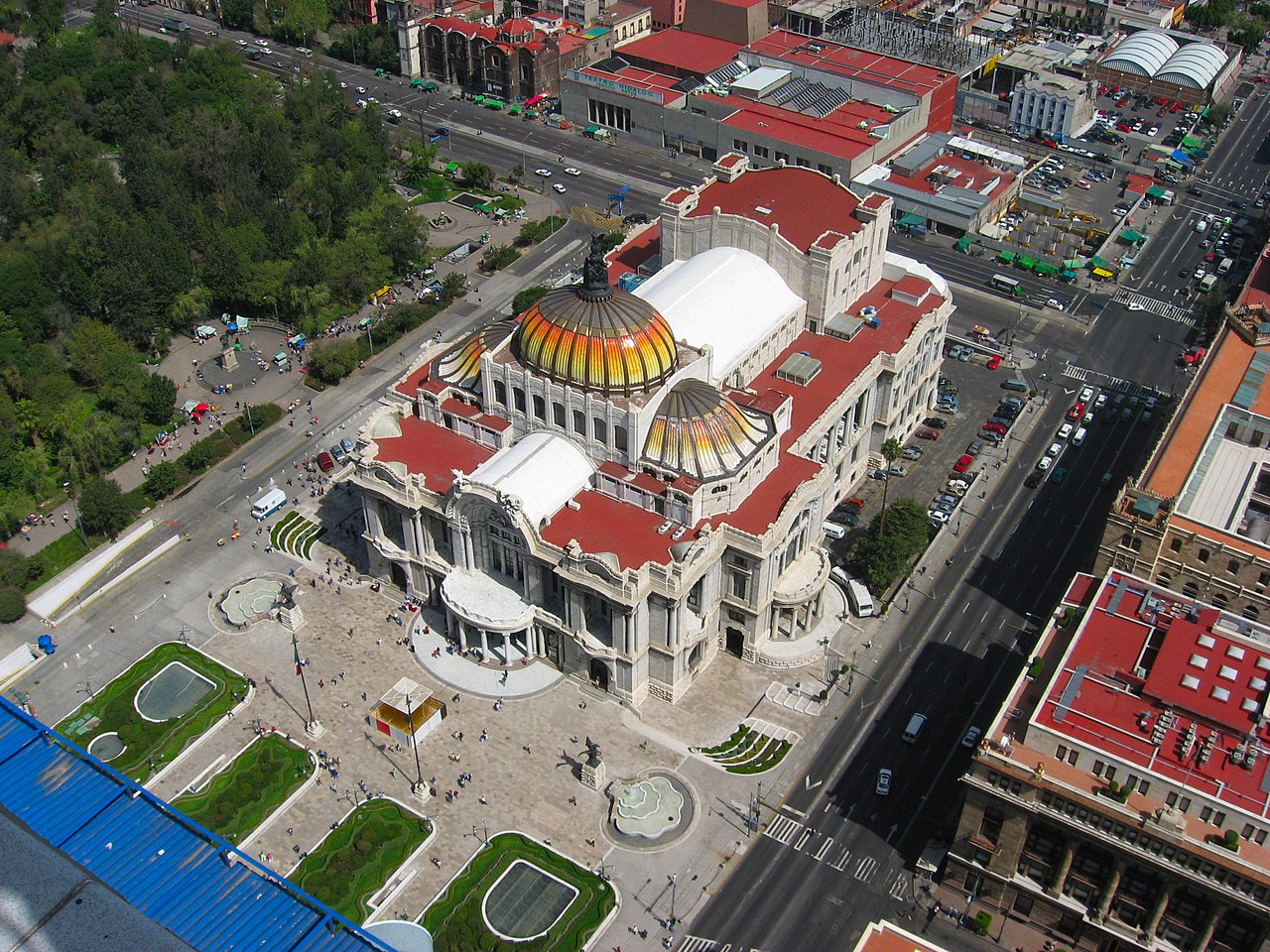
The Palacio de Bellas Artes in Mexico City.© Jeses · CC BY-SA 2.5 
The Aztec Sun Stone in the Anthropology Museum.© Gary Todd · CC0 Explore the heart of the city: the Templo Mayor, the excavated Aztec great temple beside the cathedral, the Art Nouveau Palacio de Bellas Artes with its Rivera and Orozco murals, and — unmissable — the National Museum of Anthropology, one of the world's finest, home to the Aztec Sun Stone and treasures from every ancient Mexican culture.
The Anthropology Museum is a wonder in itself — room after room laying out three thousand years of Mexican civilisations, culminating in the colossal Aztec Sun Stone. It's the perfect primer for all the ruins to come, and you could happily lose a whole day in it.
Our take
Give the Anthropology Museum at least half a day. Time the Palacio de Bellas Artes for the famous Ballet Folklórico if it's on — a spectacular night out.
Highlights
- ✦ Anthropology Museum
- ✦ Palacio de Bellas Artes
- ✦ Templo Mayor
- 3

The Pyramid of the Sun at Teotihuacán.© Daniel Case · CC BY-SA 3.0 
Frida Kahlo's Casa Azul in Coyoacán.© Rebeccananonof · CC0 Drive out to Teotihuacán, the vast ancient city whose Pyramids of the Sun and Moon line the Avenue of the Dead — built over 1,500 years ago and still awe-inspiring. Back in town, wander the cobbled, bougainvillea-draped streets of Coyoacán and visit the Casa Azul, the cobalt-blue home and studio of Frida Kahlo.
Standing on the Avenue of the Dead, the Pyramid of the Sun rising vast ahead and the Pyramid of the Moon behind, you feel the scale of a city that was one of the largest on earth when Rome was falling — and nobody even knows for sure who built it.
Our take
Go to Teotihuacán early to beat the heat and crowds (you can no longer climb the pyramids, but the scale is still staggering). Book the Casa Azul online in advance — it sells out.
Highlights
- ✦ Teotihuacán pyramids
- ✦ Casa Azul (Frida Kahlo)
- 4

Swimming in a Yucatán cenote.© Shinya Suzuki · CC BY 2.0 Getting there: Fly Mexico City → Cancún/Mérida; transfer inland to Valladolid
Fly to the Yucatán and head inland to the pretty colonial town of Valladolid, your base for the great Maya sites. Cool off in your first cenote — one of the thousands of crystal-clear freshwater sinkholes that riddle the peninsula, sacred to the Maya, where you swim in jewel-bright water beneath hanging vines and shafts of light.
Lowering yourself into a cenote — the water impossibly clear and cool, fish darting below, vines and roots trailing from the cave mouth high above, the light slanting down in beams — is a magical, slightly otherworldly swim, and one of the Yucatán's great pleasures.
Our take
Valladolid is a calm, colourful base, far nicer than staying in Cancún, with cenotes right in and around town. Wear reef-safe (biodegradable) sunscreen, or none, to protect the cenotes.
Highlights
- ✦ First cenote swim
- ✦ Valladolid
- 5
El Castillo, the great pyramid of Chichén Itzá.© Daniel Schwen · CC BY-SA 4.0 Visit Chichén Itzá, the most famous Maya city and a New Wonder of the World, dominated by the perfect stepped pyramid of El Castillo (the Temple of Kukulcán). Explore the vast ball court, the Temple of the Warriors and the sacred cenote, and learn how the pyramid was built as a giant calendar in stone.
El Castillo is mathematical magic in stone — 365 steps for the days of the year, and twice a year the afternoon sun casts a shadow-serpent slithering down its staircase. Standing before it, the scale and precision of Maya astronomy and engineering hits you all at once.
Our take
Go right at opening (from Valladolid you can beat the Cancún tour buses) for cooler air, thinner crowds and the best light. A guide really brings the astronomy and history alive.
Highlights
- ✦ El Castillo pyramid
- ✦ The Great Ball Court
- 6

The Maya ruins of Tulum above the Caribbean.© Martin Falbisoner · CC BY-SA 4.0 
A white-sand Caribbean beach on the Riviera Maya.© Ana Beatriz Vega González · CC BY-SA 4.0 Getting there: Transfer to the coast at Tulum (about 2h)
Head to the Caribbean coast and Tulum, where a compact Maya walled city sits dramatically on a cliff above a turquoise sea and a perfect white-sand beach. Explore the ruins in the morning light, then swim and laze on the beach below, and dive into one more cenote in the surrounding jungle.
Tulum is the only Maya city built right on the sea, and the combination is unforgettable — grey stone temples on a low cliff, an iguana basking on the wall, and below it that impossible Caribbean turquoise stretching to the horizon. History and beach in one perfect frame.
Our take
See the Tulum ruins at opening before the heat and crowds. The nearby Gran Cenote and Dos Ojos are superb for snorkelling among stalactites.
Highlights
- ✦ Tulum ruins
- ✦ Caribbean beach
- 7

Heading home... already planning the next trip.© Tobias1984 · CC BY-SA 3.0 Getting there: Fly home from Cancún (CUN)
A last Caribbean morning, then the drive up to Cancún for your flight home. Want more? The 15-day route keeps going — to the food and ruins of Oaxaca, colonial Mérida and the pyramids of Uxmal, and more of the Riviera Maya.
A week in Mexico — the capital's energy, Teotihuacán's pyramids, the Maya cities and that Caribbean blue — leaves you happily overfed on tacos and certain there's a whole vast country still to come back for.
Our take
Cancún airport is busy — leave plenty of time. Carry home some real Mexican vanilla, chocolate or chiles.
Highlights
- ✦ Last Caribbean swim
- ✦ Fly home from Cancún
Where to stay
The best neighbourhood to base yourself in each area, by budget. We point you to the right zone — then you pick and book the place that fits.
Mexico City
- Backpacker · Centro / Roma
- Hostels and budget hotels in the historic centre or hip Roma.
- Mid-range · Roma / Condesa
- Stylish boutique hotels in the leafy, walkable, food-filled neighbourhoods.
- Comfort · Polanco / Roma
- Luxury hotels in upscale Polanco or design hotels in Roma-Condesa.
Oaxaca
- Backpacker · Centro
- Budget guesthouses and hostels in the walkable colonial centre.
- Mid-range · Centro
- Charming boutique hotels in colonial courtyards near Santo Domingo.
- Comfort · Centro Histórico
- Luxury hotels in restored colonial mansions in the heart of the city.
Chiapas (San Cristóbal)
- Backpacker · Centro / Real de Guadalupe
- Cosy budget posadas and hostels on the lively pedestrian streets.
- Mid-range · Centro
- Boutique hotels in colonial houses around the centre.
- Comfort · Centro / outskirts
- Upscale boutique stays and country hotels just outside town.
Mérida & Valladolid
- Backpacker · Centro
- Budget rooms and hostels in the colonial centres, walkable to the plazas.
- Mid-range · Centro
- Boutique hotels in restored mansions with courtyard pools.
- Comfort · Paseo de Montejo / haciendas
- Grand mansion hotels or restored country haciendas in the Yucatán.
Riviera Maya (Tulum)
- Backpacker · Tulum town / Playa centre
- Hostels and budget hotels in town, a cheap colectivo from the beach.
- Mid-range · Tulum / Playa del Carmen
- Boutique hotels and cabañas near the beach and Quinta Avenida.
- Comfort · Beach zone / Riviera resorts
- Design beach hotels in Tulum or all-inclusive resorts along the Riviera.
We may earn a commission from bookings made through these links, at no extra cost to you.
At a glance
Best time to go
The dry season, November to April, is the best time — warm, sunny days, ideal for ruins, cities and the coast. May and June are hot before the rains; July to October is the rainy season, with afternoon storms and, on the Caribbean, hurricane risk (roughly June–November). The Day of the Dead (late October–early November) is a magical, if busy, time to visit, especially in Oaxaca and Mexico City.
Currency
MXN (Mexican peso, $)
Language
Spanish is the language, alongside 68 recognised indigenous languages — you'll hear Zapotec in Oaxaca, Tzotzil in Chiapas and Maya in the Yucatán. English is spoken in the main tourist areas, but Spanish goes a long way (and for Spanish speakers, it's home).
Visa & entry
Most nationalities (including the EU, UK, US, Canada and Australia) can visit Mexico visa-free as tourists, commonly for up to 180 days, receiving an entry permit on arrival. Always confirm the current rules and the length of stay granted for your nationality before you travel.
Daily budget
Mexico offers great value across the board. Plan roughly €40–90 per person per day for comfortable hotels, restaurant meals, internal flights and tours; backpackers spend far less, and the Riviera Maya resorts cost more. Figures are approximate.
Getting around
Distances are big, so cheap domestic flights (Aeroméxico, Volaris, VivaAerobús) link Mexico City, Oaxaca, Chiapas and the Yucatán. The comfortable ADO bus network is excellent across the south and the Yucatán, colectivos cover shorter hops on the Riviera, and the new Tren Maya links Yucatán sites. A rental car is great for the Yucatán; in Mexico City use the metro and Uber.
Safety
The tourist regions in this guide — Mexico City, Oaxaca, the San Cristóbal and Palenque areas of Chiapas, the Yucatán and the Riviera Maya — are generally safe with normal precautions. Watch for petty theft, use registered taxis or Uber (especially at night), don't flash valuables, and keep to well-travelled routes. Security varies a lot by state, so always check your government's latest travel advice before and during your trip.
Connectivity
A local SIM (Telcel has the best coverage, or AT&T/Movistar) is cheap and easy, or use a travel eSIM. Coverage is good in cities and tourist areas, patchier in the deep jungle and remote highlands. Wi-Fi is standard in hotels, cafés and restaurants.
What to pack — Mexico
Our recommended gear for this trip — country-specific picks first, then the travel essentials we never leave home without.
- 🧴Reef-safe sunscreen→
- 🦟Insect repellent (jungle & cenotes)→
- 👟Comfortable shoes (ruins)→
- 🧥Light layer (highlands cool nights)→
- 🔌Universal travel adapter→
- 🧳Packing cubes→
- 🔋Power bank→
- 🎒Packable daypack→
- 💧Filtered water bottle→
- ⛑️Travel first-aid kit→
Amazon affiliate links — we may earn a small commission at no extra cost to you.
Frequently asked questions
When is the best time to visit Mexico? +
The dry season, November to April, is best — warm, sunny and ideal for ruins, cities and the coast. May–June are hot; July–October is the rainy season, with Caribbean hurricane risk roughly June–November. The Day of the Dead (late October–early November) is a magical, busy time, especially in Oaxaca and Mexico City.
Do I need a visa for Mexico? +
Most nationalities (including the EU, UK, US, Canada and Australia) can visit visa-free as tourists, commonly for up to 180 days, with an entry permit issued on arrival. Always confirm the current rules and the stay granted for your nationality before you travel.
Is Mexico safe to travel in? +
The tourist regions in this guide — Mexico City, Oaxaca, the San Cristóbal and Palenque areas, the Yucatán and the Riviera Maya — are generally safe with normal precautions: use registered taxis or Uber, don't flash valuables, and keep to well-travelled routes. Security varies a lot by state, so always check your government's latest travel advice before and during your trip.
How do I get around Mexico? +
Distances are big, so cheap domestic flights (Aeroméxico, Volaris, VivaAerobús) link the main regions. The comfortable ADO bus network is excellent across the south and Yucatán, colectivos cover the Riviera, and the new Tren Maya links Yucatán sites. A rental car is great for the Yucatán; in Mexico City, use the metro and Uber.
Sources
Last reviewed on June 5, 2026Facts in this guide were checked against the following sources.
- VisitMéxico — official tourism — Destinations and travel basics
- INAH — National Institute of Anthropology & History — Archaeological sites & museums
- Mexico immigration (INM) — Visa & entry requirements
- UNESCO World Heritage — Mexico — Heritage sites (Teotihuacán, Oaxaca, Palenque, Chichén Itzá)
⚠️ Prices, opening hours and transport times change — always verify the latest details before you travel.
Keep exploring
More day-by-day itineraries to inspire your next trip.

USA East Coast
New York, Washington DC, Boston, Niagara Falls and the colours of New England.

Japan
Neon cities, ancient temples and bullet trains — the perfect first trip to Asia.

Italy
Ancient ruins, Renaissance art, impossible coastlines and the best food on earth.

Thailand
Golden temples, jungle and elephants, street food and impossibly blue islands.

Vietnam
Limestone bays, lantern-lit towns, terraced mountains and the food of your life.

Indonesia
Smoking volcanoes, rice-terrace temples, turquoise islands and dragons.