

Oceania
Australia
Sydney and the Red Centre, the Great Barrier Reef, Melbourne and the Great Ocean Road.
- Sydney
- Uluru & the Red Centre
- Great Barrier Reef
- Melbourne
- Great Ocean Road
- Kangaroos & koalas
Australia is a country the size of a continent, and a trip here means embracing its vast distances and astonishing variety. Begin in glamorous Sydney, with its iconic Opera House, sparkling harbour and golden beaches, then escape to the misty eucalyptus forests of the Blue Mountains. Fly to the spiritual heart of the country, the Red Centre, where Uluru glows at sunset over the ancient desert. Snorkel the kaleidoscopic Great Barrier Reef and walk the world's oldest rainforest at Daintree, sail the dazzling white sands of the Whitsundays, and discover cool, creative Melbourne with its laneways, coffee and the cliffs and Twelve Apostles of the Great Ocean Road. Add the wine country of the Barossa and the wildlife of Kangaroo Island, with kangaroos and koalas along the way, and you have one of the world's great journeys — perfect over 7, 15 or 21 days.
Build your trip
Tune it to you, then export it.
Length
Travel style
Your interests
The essentials: harbourside Sydney, the Blue Mountains, and the Great Barrier Reef and Daintree rainforest at Cairns.
Daily budget:≈ €120–220 / day
Comfortable hotels and motels, eating out, internal flights, a hire car and the big-ticket reef, Reef and Outback tours.
Day by day
- 1
The sails of the Sydney Opera House on the harbour.© Diliff · CC BY-SA 3.0 Getting there: Fly into Sydney (SYD); transfer to your hotel
Arrive in Sydney, Australia's dazzling harbour city. After the long flight, ease in gently around Circular Quay, where the sail-shaped Opera House and the great steel arch of the Harbour Bridge frame one of the most beautiful waterfronts on earth. Stroll the historic Rocks district and enjoy a first dinner by the water.
Few cities announce themselves like Sydney — that first sight of the Opera House and the Bridge across the blue harbour, ferries crisscrossing the water, is pure arrival magic, and tells you instantly you've reached somewhere special.
Our take
Jet lag is real after the long haul — take day one slowly. Staying near Circular Quay or The Rocks puts you in the heart of the harbour.
Highlights
- ✦ Opera House & Harbour Bridge
- ✦ The Rocks
- 2
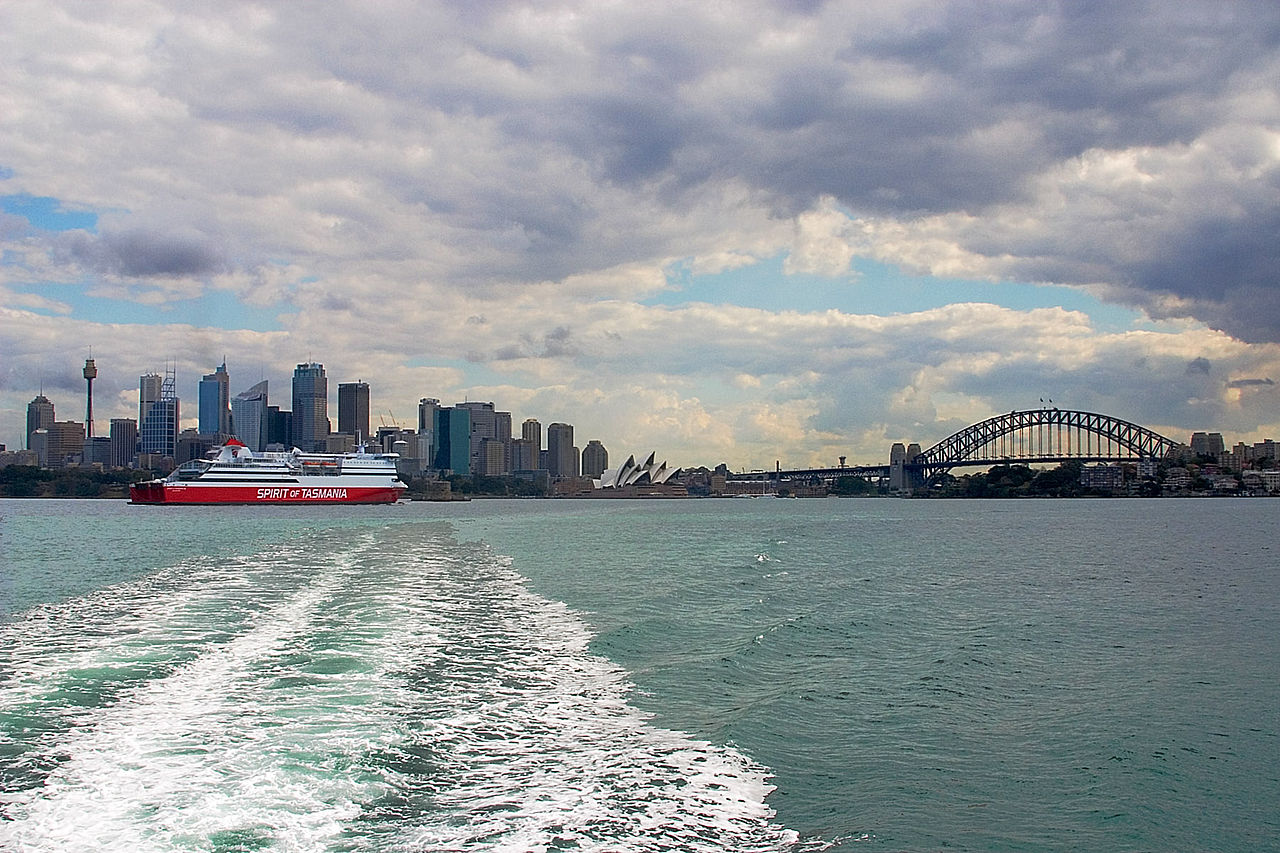
Sydney Harbour, the Bridge and the city skyline.© Mfunnell · CC BY-SA 3.0 
The golden crescent of Bondi Beach, Sydney.© Dronepicr · CC BY 3.0 Dive into Sydney. Tour the Opera House, climb or walk the Harbour Bridge, and ride a ferry across the harbour to Manly or Taronga Zoo for the classic view back to the city. In the afternoon, head to world-famous Bondi Beach and walk the spectacular clifftop coastal path to Coogee, past coves and rock pools.
A Sydney ferry ride is one of travel's great cheap thrills — the city skyline, the Opera House and the Bridge sliding past as you cross the sparkling harbour. And the Bondi-to-Coogee walk, all turquoise coves and crashing surf, shows you why Sydneysiders are obsessed with their coast.
Our take
Catch the Manly ferry just for the ride — it's the best-value harbour cruise in town. On the beaches, always swim between the flags.
Highlights
- ✦ Harbour ferry
- ✦ Bondi to Coogee walk
- 3

The Three Sisters in the Blue Mountains, near Sydney.© Dietmar Rabich · CC BY-SA 4.0 Getting there: Day trip Sydney → Blue Mountains (about 1.5h each way)
Take a day trip into the Blue Mountains, a UNESCO-listed wilderness of deep eucalyptus-clad valleys that shimmer blue in the haze of the gum trees. Admire the iconic Three Sisters rock formation at Echo Point, ride the steep Scenic Railway, and walk forest trails past waterfalls and dramatic clifftop lookouts.
The Blue Mountains really do shimmer blue — a haze of eucalyptus oil hanging over endless forested valleys, with the Three Sisters standing sentinel over the gulf. After the buzz of the harbour, the cool, scented mountain air is a tonic.
Our take
Katoomba and Leura make good bases. Beat the coach crowds at Echo Point by arriving early, and lace up for at least one short forest walk.
Highlights
- ✦ Three Sisters
- ✦ Scenic Railway
- 4

The Great Barrier Reef from the air, Queensland.© Ank Kumar · CC BY-SA 4.0 Getting there: Fly Sydney → Cairns (about 3h)
Fly north to tropical Cairns, the gateway to the Great Barrier Reef. Swap the big-city pace for laid-back tropical heat: stroll the waterfront Esplanade and its lagoon pool, and get your bearings for tomorrow's big day out on the reef. Settle in and savour the warm, palm-fringed northern air.
Stepping off the plane in Cairns, the wall of tropical warmth and the smell of the sea tell you you've reached the edge of one of the planet's great natural wonders — and tomorrow you'll be in the water above it.
Our take
Cairns itself has no beach (use the lagoon or nearby Palm Cove); it's really a reef base. Book your reef trip for tomorrow now if you haven't already.
Highlights
- ✦ Cairns Esplanade
- ✦ Tropical north
- 5

Snorkelling among coral and fish on the Great Barrier Reef.© Steve Evans · CC BY 2.0 Getting there: Boat trip to the outer Great Barrier Reef & back
Sail out to the Great Barrier Reef, the largest living structure on earth and one of the seven natural wonders of the world. Snorkel or dive over a kaleidoscope of corals teeming with clownfish, parrotfish, rays, reef sharks and perhaps a sea turtle gliding by. It's a day in another world, beneath the warm Coral Sea.
The first time you put your face in the water over the Great Barrier Reef, the sheer abundance is overwhelming — coral gardens in every colour, clouds of fish parting around you, the dappled blue stretching down forever. It's one of those rare experiences that exceeds every expectation.
Our take
Choose an operator that visits the outer reef for the best coral and visibility. Even non-swimmers can join — there are pontoons, glass-bottom boats and intro dives.
Highlights
- ✦ Great Barrier Reef
- ✦ Snorkelling & diving
- 6

The ancient rainforest canopy of Daintree National Park.© John Robert McPherson · CC BY-SA 4.0 
A koala dozing in a eucalyptus tree.© Arnas Goldberg · CC BY 3.0 Getting there: Day trip to the Daintree & Cape Tribulation
Head north to the Daintree, the oldest surviving tropical rainforest on earth — around 180 million years old — where the jungle tumbles right down to the Coral Sea at Cape Tribulation. Take a boardwalk through the dense green, cruise the river to spot crocodiles, and learn about the forest from its Indigenous custodians. Watch for koalas and wildlife on the way.
In the Daintree, you walk among plants that have barely changed since the dinosaurs — vast buttressed trees, strangler figs and ferns dripping in the humid green, the air loud with birdsong. And at Cape Tribulation, two World Heritage wonders meet: the oldest rainforest spilling onto the reef-fringed sea.
Our take
An Indigenous-guided walk adds real depth. Heed the crocodile warnings — never swim in the rivers or estuaries up here.
Highlights
- ✦ Daintree Rainforest
- ✦ Cape Tribulation
- 7

Heading home... already planning the next trip.© Tobias1984 · CC BY-SA 3.0 Getting there: Fly home from Cairns (CNS), often via Sydney
A final tropical morning — perhaps the Cairns lagoon or a last coffee on the Esplanade — then the long flight home. Want more? The 15-day route adds the spiritual Red Centre and Uluru, cool creative Melbourne and the cliffs of the Great Ocean Road.
A week in Australia — harbourside Sydney, the misty Blue Mountains, the Great Barrier Reef and the ancient Daintree — barely scratches this vast country, and leaves you already plotting the flights back for everything you didn't reach.
Our take
Cairns flights home usually connect through Sydney, Brisbane or Melbourne — leave a comfortable buffer for the transfer.
Highlights
- ✦ Last tropical morning
- ✦ Fly home
Where to stay
The best neighbourhood to base yourself in each area, by budget. We point you to the right zone — then you pick and book the place that fits.
Sydney
- Backpacker · Surry Hills / Newtown
- Hostels and budget rooms in lively, foodie inner-city neighbourhoods.
- Mid-range · The Rocks / CBD
- Comfortable hotels by the harbour, walkable to the Opera House and ferries.
- Comfort · Circular Quay
- Luxury hotels with harbour and Opera House views.
Red Centre (Uluru)
- Backpacker · Ayers Rock Resort (Outback Pioneer)
- Budget lodge rooms and a campground at Yulara, the only base near Uluru.
- Mid-range · Ayers Rock Resort (Desert Gardens / Sails)
- Comfortable hotels at Yulara, some with rock views.
- Comfort · Longitude 131°
- Luxury tented suites with direct views of Uluru.
Cairns & the Reef
- Backpacker · Cairns city
- Plenty of hostels near the Esplanade and reef-trip departure points.
- Mid-range · Cairns / Palm Cove
- Comfortable hotels in town or the beachy resort village of Palm Cove.
- Comfort · Port Douglas
- Upscale resorts in the chic gateway to the reef and Daintree.
Melbourne
- Backpacker · Fitzroy / CBD
- Hostels in the bohemian inner north or the walkable centre.
- Mid-range · CBD / Southbank
- Comfortable hotels by the river, trams and laneways.
- Comfort · Southbank / East End
- Upscale hotels near the arts precinct and fine dining.
Adelaide & Kangaroo Island
- Backpacker · Adelaide CBD
- Central hostels near the Central Market; island hostels at Kingscote/Penneshaw.
- Mid-range · Adelaide / North Adelaide
- Comfortable city hotels, plus guesthouses and eco-stays on Kangaroo Island.
- Comfort · Kangaroo Island lodges
- Luxury wilderness lodges like Southern Ocean Lodge above the sea.
We may earn a commission from bookings made through these links, at no extra cost to you.
At a glance
Best time to go
Australia is vast, so the "best" time depends on where you go — and the seasons are flipped (summer is December–February, winter June–August). The southern cities (Sydney, Melbourne, Adelaide) are loveliest in spring (Sep–Nov) and autumn (Mar–May). The tropical north (Cairns, the Reef, the Whitsundays) is best in the dry season, May–October, avoiding the hot, wet, jellyfish-prone summer. The Red Centre (Uluru) is most comfortable in the cooler months, April–September. Aim for the shoulder seasons and you can combine most of the country pleasantly.
Currency
AUD (Australian dollar, $)
Language
English is the national language. Australia is also home to hundreds of Aboriginal and Torres Strait Islander languages, the oldest living cultures on earth — and you'll meet plenty of place names, like Uluru and Kata Tjuta, drawn from them.
Visa & entry
Almost every visitor needs travel authorisation before arriving — most can apply online: an ETA (Electronic Travel Authority) for nationalities such as the US, UK and Canada, or the free eVisitor visa for EU/EEA passport holders. Both are quick and electronic but must be arranged in advance. Always confirm the current requirements for your nationality well before you travel.
Daily budget
Australia is one of the more expensive destinations: wages and prices are high. Plan roughly €120–220 per person per day for comfortable hotels, eating out, internal flights and tours; backpackers using hostels, self-catering and buses spend much less, while luxury lodges and reef or Outback trips cost more. Figures are approximate.
Getting around
Distances are enormous, so domestic flights (Qantas, Virgin Australia, Jetstar) are essential for linking the cities, the Red Centre and the Reef — book ahead for the best fares. Self-driving is the joy of trips like the Great Ocean Road, the Blue Mountains and Kangaroo Island; remember Australians drive on the left. Cities have good public transport (Sydney's ferries are a highlight), and long-distance trains exist but are slow and scenic rather than practical.
Safety
Australia is very safe, with low crime — the main risks are natural. The sun is fierce (the world's highest UV): wear a hat, high-SPF sunscreen and cover up. On beaches, always swim between the red-and-yellow flags, where surf lifesavers patrol. Respect the wildlife — keep your distance from snakes and spiders, heed marine-stinger (box jellyfish) warnings in the tropical north in summer, and never swim where crocodile signs are posted in Far North Queensland and the Top End. Check fire warnings in bushfire season.
Connectivity
Mobile coverage (Telstra has the widest reach, plus Optus and Vodafone) is good in cities and towns, and a local SIM or travel eSIM is easy to set up — but signal drops away fast in the Outback and on remote stretches of road, so download maps offline. Wi-Fi is common in hotels, cafés and libraries.
What to pack — Australia
Our recommended gear for this trip — country-specific picks first, then the travel essentials we never leave home without.
- 🧴High-SPF sunscreen→
- 🧢Sun hat & sunglasses→
- 🤿Snorkel & reef-safe gear→
- 🥾Walking shoes (canyons & coast)→
- 🔌Universal travel adapter→
- 🧳Packing cubes→
- 🔋Power bank→
- 🎒Packable daypack→
- 💧Filtered water bottle→
- ⛑️Travel first-aid kit→
Amazon affiliate links — we may earn a small commission at no extra cost to you.
Frequently asked questions
When is the best time to visit Australia? +
It depends on the region, and the seasons are reversed (summer is Dec–Feb). The southern cities (Sydney, Melbourne, Adelaide) shine in spring (Sep–Nov) and autumn (Mar–May). The tropical north and the Reef are best in the dry season, May–October. The Red Centre is most comfortable April–September. Shoulder seasons let you combine most of the country pleasantly.
Do I need a visa for Australia? +
Almost everyone does — but most can apply online before travelling: an ETA (Electronic Travel Authority) for nationalities such as the US, UK and Canada, or the free eVisitor visa for EU/EEA citizens. Both are electronic and usually quick, but must be arranged in advance. Confirm the current requirements for your passport well before you go.
How do I get around such a big country? +
Distances are huge, so domestic flights (Qantas, Virgin Australia, Jetstar) are essential for linking the cities, the Red Centre, the Reef and the Whitsundays — book ahead. Self-driving is the joy of regional trips like the Great Ocean Road, the Blue Mountains and Kangaroo Island (remember: drive on the left). Cities have good public transport, and Sydney's ferries are a highlight.
Is Australia safe, and what about the wildlife? +
Australia is very safe, with low crime; the main risks are natural. The sun is intense, so cover up and use high-SPF sunscreen. Always swim between the flags on patrolled beaches. Dangerous wildlife exists but is rarely a problem if you're sensible: keep your distance from snakes and spiders, heed marine-stinger warnings in the tropical north in summer, and never swim where crocodile signs are posted in the far north.
Sources
Last reviewed on June 11, 2026Facts in this guide were checked against the following sources.
- Tourism Australia — official tourism — Destinations and travel basics
- Australian ETA / Home Affairs — Visa & ETA requirements
- Parks Australia — Uluru-Kata Tjuta — Uluru & the Red Centre
- Great Barrier Reef Marine Park Authority — The Great Barrier Reef
⚠️ Prices, opening hours and transport times change — always verify the latest details before you travel.
Keep exploring
More day-by-day itineraries to inspire your next trip.

New Zealand
Milford Sound, Queenstown, Mount Cook and Rotorua — a two-island road-trip through Middle-earth.

Japan
Neon cities, ancient temples and bullet trains — the perfect first trip to Asia.

Italy
Ancient ruins, Renaissance art, impossible coastlines and the best food on earth.

Thailand
Golden temples, jungle and elephants, street food and impossibly blue islands.

Vietnam
Limestone bays, lantern-lit towns, terraced mountains and the food of your life.

Indonesia
Smoking volcanoes, rice-terrace temples, turquoise islands and dragons.