

East Asia
China
The Great Wall, the Terracotta Army, pandas, karst rivers and neon Shanghai.
- The Great Wall
- Forbidden City
- Terracotta Army
- Chengdu pandas
- Li River karst
- Shanghai
This is the classic first trip to China: the imperial heart of Beijing and the Great Wall, the Terracotta Army of Xi'an, the giant pandas of Chengdu, the dreamlike karst landscapes around Yangshuo and the futuristic skyline of Shanghai. Knitted together by the world's best high-speed rail, it packs five thousand years of history and one of the planet's most dynamic countries into a single, jaw-dropping route.
Build your trip
Tune it to you, then export it.
Length
Travel style
Your interests
The essential first taste of China: imperial Beijing and the Great Wall, the Terracotta Army of Xi'an and the dazzle of Shanghai.
Daily budget:≈ €55–110 / day
Comfortable hotels, restaurant meals, first-class high-speed trains, domestic flights and guided sights.
Day by day
- 1

Peking duck, sliced and ready.© Peachyeung316 · CC BY-SA 4.0 Land in Beijing, set up your VPN and a mobile-payment app, and ease in gently. Wander a lantern-lit hutong, get your bearings around Qianmen, and mark your arrival with the city's signature feast: crispy, lacquered Peking duck, carved at the table.
That first evening, the sheer scale of Beijing hits you — vast avenues, a skyline of cranes and history, and an energy that tells you this is a country moving at full speed. Then a slice of duck wrapped in a pancake quietly reminds you it's also five thousand years old.
Our take
Sort the VPN and Alipay/WeChat Pay before you even leave the airport — everything downstream is easier with them. Don't over-plan day one; jet lag plus duck is plenty.
Highlights
- ✦ First hutong walk
- ✦ Peking duck dinner
- 2

Tiananmen Gate, lit up at night.© Charlie fong冯成 · Public domain 
The Forbidden City, imperial heart of Beijing.© CEphoto, Uwe Aranas · CC BY-SA 3.0 
The Hall of Prayer for Good Harvests at the Temple of Heaven.© Maros M r a z (Maros) · CC BY-SA 3.0 Cross vast Tiananmen Square to the Forbidden City, the largest palace complex on earth and home to the emperors for five centuries. In the afternoon, find calm at the Temple of Heaven, where the circular Hall of Prayer for Good Harvests is one of China's most perfect buildings.
Walking the central axis of the Forbidden City, hall after hall after hall, you feel the deliberate weight of imperial power — designed to make you feel small. At the Temple of Heaven, locals practising tai chi and playing cards under the cypresses bring it all back to human scale.
Our take
Book Forbidden City tickets online in advance (passport required) — they sell out and walk-ups are turned away. Enter from the south (Tiananmen) and walk north so you exit by the hill with the city view.
Highlights
- ✦ Tiananmen Square
- ✦ Forbidden City
- ✦ Temple of Heaven
- 3
The Great Wall snaking over the hills.© Velatrix · CC0 
Longevity Hill over Kunming Lake, the Summer Palace.© xiquinhosilva · CC BY 2.0 Head out of the city to walk the Great Wall — the Mutianyu section is beautifully restored, less crowded than Badaling, and reached by cable car. Spend the morning hiking its watchtowers along the ridgelines, then return via the lake and pavilions of the Summer Palace.
Standing on the Wall as it ripples over the mountains to the horizon in both directions, you finally grasp the insane ambition of it. It's one of those rare sights that's even bigger in person than in your head — a genuine pinch-yourself moment.
Our take
Choose Mutianyu over Badaling for fewer crowds and better hiking, and go early. The toboggan ride down is silly fun and saves your knees.
Highlights
- ✦ Great Wall at Mutianyu
- ✦ Summer Palace
- 4

A hutong lane in old Beijing.© Anagoria · CC BY 3.0 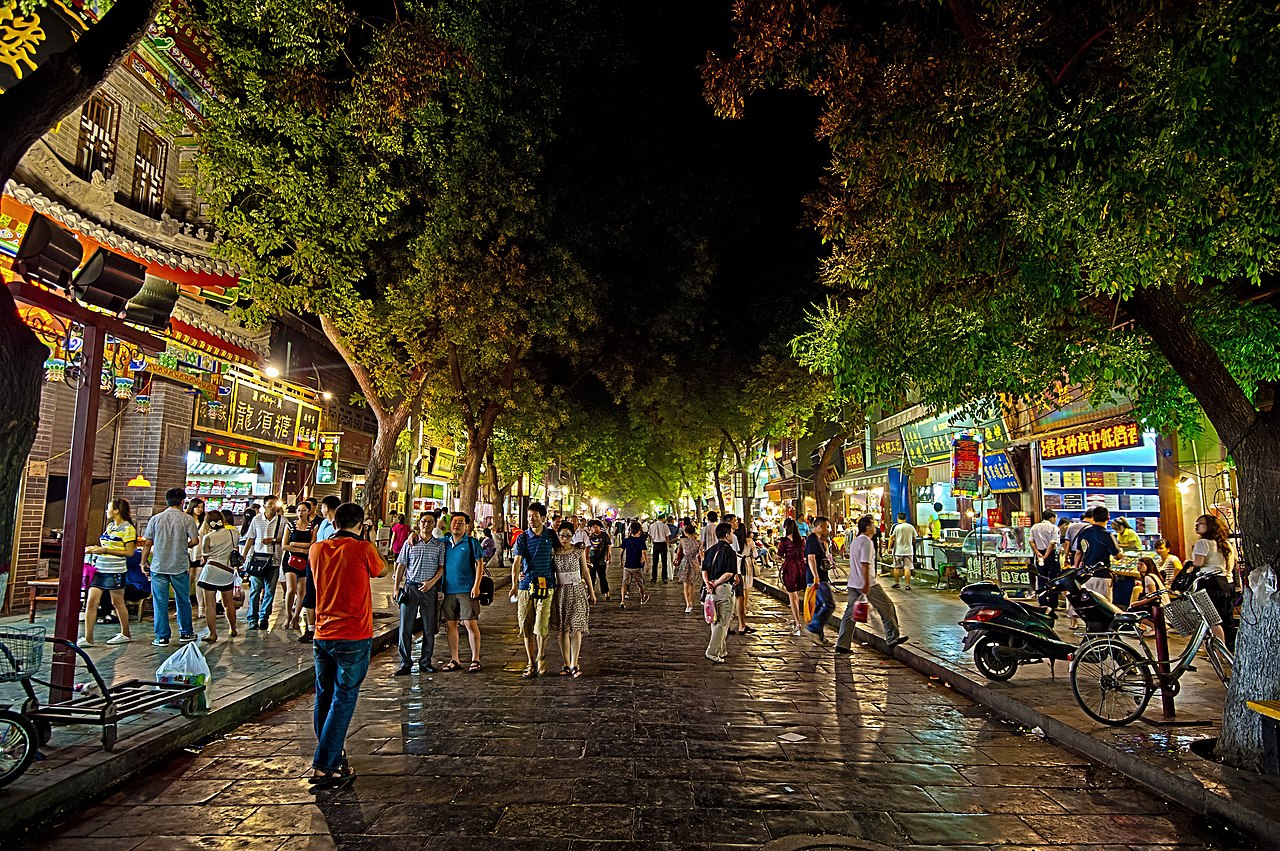
Street food in Xi'an's Muslim Quarter.© chensiyuan · CC BY-SA 4.0 Getting there: High-speed train Beijing → Xi'an (about 4h30–6h)
Spend the morning in Beijing's hutongs — the grey-brick alleys and courtyard homes of the old city, best explored on foot or by cycle rickshaw. Then board a high-speed train south to Xi'an, ancient capital of thirteen dynasties, and dive into the sizzling street food of its Muslim Quarter.
The hutongs are the soul of old Beijing — birdsong in cages, old men with newspapers, the clack of mahjong — a world away from the glass towers. Hours later you step off a spotless 300 km/h train into Xi'an, where lamb skewers smoke over coals and the call to prayer drifts over a thousand-year-old neighbourhood.
Our take
Book the train a few days ahead and pick a morning departure to enjoy Xi'an by night. Come hungry to the Muslim Quarter — the roujiamo (Chinese "hamburger") and hand-pulled noodles are the stars.
Highlights
- ✦ Beijing hutongs
- ✦ Xi'an Muslim Quarter
- 5
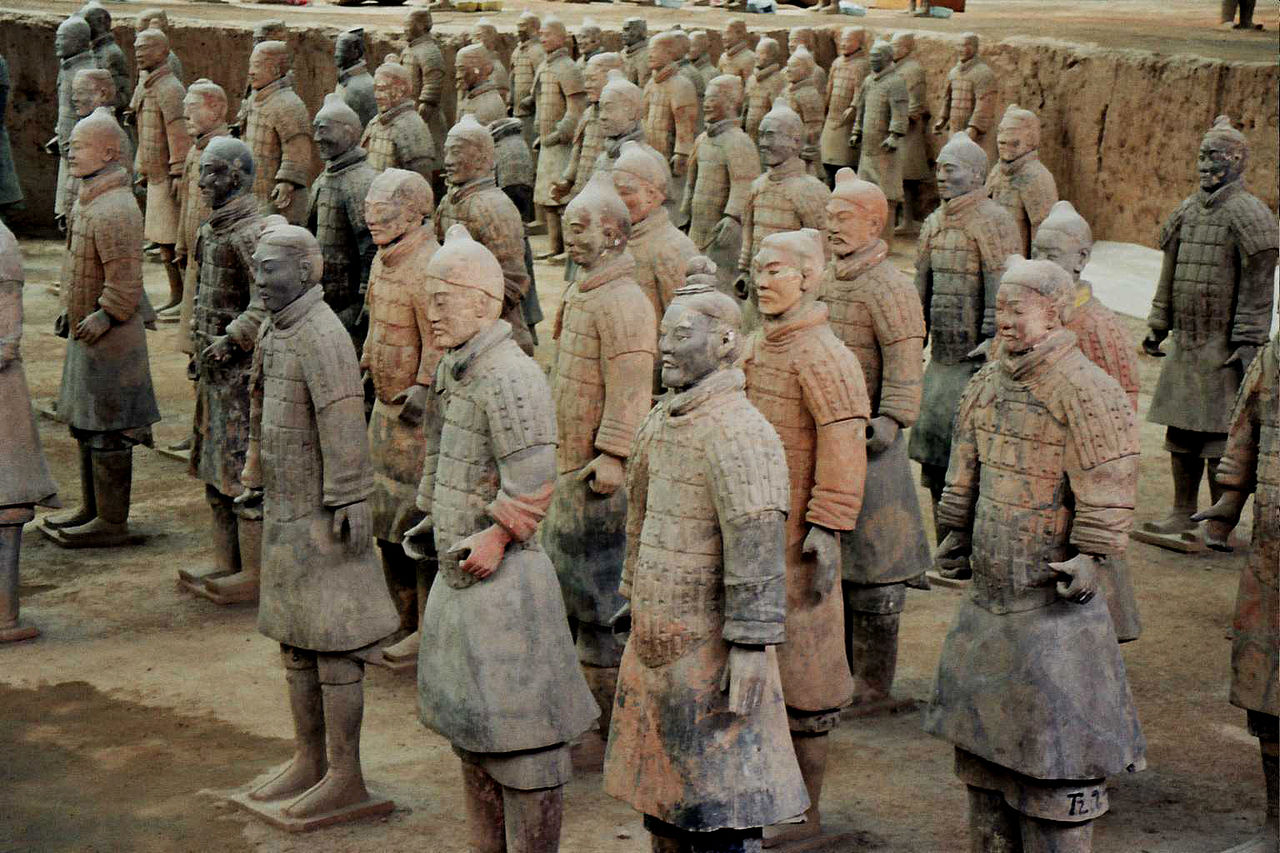
The Terracotta Army of Xi'an, up close.© User:airunp · Public domain 
Cycling the great Ming city wall of Xi'an.© Immanuel Giel · CC BY-SA 4.0 Meet the Terracotta Army: thousands of life-size warriors, each with a different face, buried for over 2,000 years to guard China's first emperor. Back in town, rent a bike and ride the full circuit of Xi'an's mighty Ming-era city wall for a sweeping view over the old capital.
Looking down into Pit 1 — rank after rank of soldiers marching into the distance — is one of the great archaeological gut-punches on earth. That a megalomaniac emperor built an entire clay army to escort him into the afterlife, and that it lay hidden until a farmer dug a well in 1974, never stops being astonishing.
Our take
Go early or late to dodge the tour-bus crush, and hire a guide or audio guide — the pits make far more sense with the story. Sunset on the city wall is the best time to cycle it.
Highlights
- ✦ Terracotta Army
- ✦ City wall by bike
- 6

The Bund and Pudong skyline at blue hour.© Dllu · CC BY-SA 4.0 
The classical Yu Garden in old Shanghai.© Rose Abrams · CC BY 4.0 
Shanghai's futuristic Pudong skyline.© King of Hearts · CC BY-SA 4.0 Getting there: Fly Xi'an → Shanghai (about 2h30)
Fly east to Shanghai, China's glittering future. Wander the classical rockeries of the Yu Garden in the old town, then walk the Bund — the curve of grand 1920s riverfront buildings facing the science-fiction skyline of Pudong, which lights up after dark into one of the world's great views.
Standing on the Bund at night, the colonial façades behind you and Pudong's neon towers blazing across the river, you feel the whole arc of modern China in a single panorama — from the treaty-port past to the supercharged present. It's pure, electric spectacle.
Our take
See the Bund at dusk to catch the lights switching on. For the skyline view, the Shanghai Tower observation deck is the highest, but a riverside bar in Pudong gives you the Bund in return.
Highlights
- ✦ The Bund
- ✦ Yu Garden
- ✦ Pudong skyline
- 7

Heading home... already planning the next trip.© Tobias1984 · CC BY-SA 3.0 Getting there: Fly home from Shanghai
Squeeze in a last breakfast of soup dumplings and a final wander before heading to the airport. Hungry for more? The 15-day route keeps going — to the pandas of Chengdu and the dreamlike karst rivers of Yangshuo.
A week in and China has already rewired your sense of scale — of history, of cities, of ambition. You'll leave a little overwhelmed and certain you've only scratched the surface, because you have.
Our take
Leave plenty of time for Shanghai's airport (the Maglev to Pudong airport hits 300 km/h and is an attraction in itself). Keep some Alipay balance for last-minute snacks.
Highlights
- ✦ Soup dumplings
- ✦ Fly home from Shanghai
Where to stay
The best neighbourhood to base yourself in each area, by budget. We point you to the right zone — then you pick and book the place that fits.
Beijing
- Backpacker · Dongcheng hutongs
- Hostels in the old alleys near Qianmen and the Drum Tower, walkable to the sights.
- Mid-range · Wangfujing / Qianmen
- Central hotels a short walk from Tiananmen and the Forbidden City.
- Comfort · Wangfujing / Financial St
- International five-stars near the centre and the palace.
Xi'an
- Backpacker · Inside the city wall
- Hostels near the Bell Tower and Muslim Quarter — everything on foot.
- Mid-range · Bell Tower area
- Central hotels by the night market and main sights.
- Comfort · Bell Tower / Qujiang
- Upscale hotels in the centre or the smart Qujiang district.
Chengdu
- Backpacker · Near People's Park
- Hostels close to teahouses, snack streets and the metro.
- Mid-range · Chunxi Road / Taikoo Li
- Central shopping-and-dining district, well connected.
- Comfort · Taikoo Li
- Design hotels by the Sino-Ocean Taikoo Li mall and Daci Temple.
Zhangjiajie
- Backpacker · Zhangjiajie city
- Cheapest beds and transport links, a bus ride from the park.
- Mid-range · Wulingyuan village
- Right by the main park gate — best for early starts on the pillars.
- Comfort · Resorts near the park
- Higher-end hotels and lodges around Wulingyuan.
Yangshuo
- Backpacker · West Street
- Hostels and bars in the buzzy heart of town.
- Mid-range · Riverside / town edge
- Hotels with karst views, a short walk from the action.
- Comfort · Countryside retreats
- Boutique resorts among the rice fields and limestone peaks.
Hangzhou
- Backpacker · Wushan / near the station
- Affordable beds a short hop from West Lake.
- Mid-range · Around West Lake
- Hotels within walking or cycling distance of the lakeshore.
- Comfort · West Lake shore
- Resort hotels with lake views and gardens.
Shanghai
- Backpacker · People's Square / Jing'an
- Central hostels on the metro, walkable to Nanjing Road.
- Mid-range · The Bund / French Concession
- Atmospheric, well-located hotels for sightseeing on foot.
- Comfort · The Bund / Lujiazui
- Luxury hotels with river and skyline views.
We may earn a commission from bookings made through these links, at no extra cost to you.
At a glance
Best time to go
Spring (April–May) and autumn (September–October) are the best times, with mild, clearer weather across the country. Summer is hot, humid and busy; winter is cold in the north (Beijing and Xi'an freeze) but quieter and crisp. Avoid the two domestic-travel crushes: the October 1–7 National Day "Golden Week" and Chinese New Year (late Jan–Feb), when everything is packed and pricey.
Currency
CNY (¥, RMB)
Language
Mandarin Chinese. English is limited outside big hotels and major sights, so a translation app (with an offline pack and camera mode) is genuinely essential — and a lifesaver for menus and signs.
Visa & entry
Most nationalities need a tourist visa arranged in advance, though many countries now enjoy visa-free trial schemes or transit visa-free stays (e.g. 144-hour transit in cities like Shanghai and Beijing). Rules are changing fast — always check your nationality's current requirements before booking.
Daily budget
China is mid-range value: plan roughly €55–110 per person per day for comfortable hotels, restaurant meals, high-speed trains and attraction tickets — sights and bullet trains add up, but food and city transport are cheap. Backpackers spend far less; figures are approximate.
Getting around
China's high-speed rail is superb — fast, punctual and the best way between cities (book ahead with your passport). Take domestic flights for the long hops to Chengdu, Zhangjiajie or Guilin. In cities the metro is cheap, modern and signed in English, and the Didi app handles taxis.
Safety
China is very safe, with low crime even late at night. The real challenges are practical: the language barrier, and the fact that Google, WhatsApp, Instagram and many Western sites are blocked. Install a reputable VPN before you arrive (you can't download one once you're there) and set up mobile payments — they run the country.
Connectivity
Behind the "Great Firewall", Google, WhatsApp, Instagram and Facebook don't work — install a VPN before you fly (a roaming eSIM can also bypass it). Daily life runs on Alipay and WeChat Pay, which now accept foreign cards; set one up, as cash and cards are rarely used.
What to pack — China
Our recommended gear for this trip — country-specific picks first, then the travel essentials we never leave home without.
- 👟Comfortable walking shoes→
- 🧻Pocket tissues & hand sanitiser→
- 🌂Compact umbrella→
- 🔌Universal travel adapter→
- 🧳Packing cubes→
- 🔋Power bank→
- 🎒Packable daypack→
- 💧Filtered water bottle→
- ⛑️Travel first-aid kit→
Amazon affiliate links — we may earn a small commission at no extra cost to you.
Frequently asked questions
When is the best time to visit China? +
Spring (April–May) and autumn (September–October) are best, with mild, clearer weather. Avoid the October 1–7 "Golden Week" and Chinese New Year, when domestic travel peaks and everything is packed and pricey.
Do I need a VPN and a special payment app? +
Yes to both. Google, WhatsApp, Instagram and many Western sites are blocked, so install a VPN before you arrive (you can't download one inside China). And set up Alipay or WeChat Pay — they now accept foreign cards and run daily life, as cash and cards are rarely used.
How do I get around between cities? +
China's high-speed trains are fast, punctual and the best option between cities (book ahead with your passport). Use domestic flights for the long hops to Chengdu, Zhangjiajie and Guilin. Within cities, the metro is cheap and signed in English.
Sources
Last reviewed on June 4, 2026Facts in this guide were checked against the following sources.
- China Discovery / official tourism info — Destinations and travel basics
- China visa & entry (National Immigration Administration) — Visa & entry requirements
- China Railway (12306) high-speed rail — Train travel & booking
- UNESCO World Heritage — China — Heritage sites (Great Wall, Terracotta Army, West Lake)
⚠️ Prices, opening hours and transport times change — always verify the latest details before you travel.
Keep exploring
More day-by-day itineraries to inspire your next trip.

Japan
Neon cities, ancient temples and bullet trains — the perfect first trip to Asia.

Thailand
Golden temples, jungle and elephants, street food and impossibly blue islands.

Vietnam
Limestone bays, lantern-lit towns, terraced mountains and the food of your life.

Indonesia
Smoking volcanoes, rice-terrace temples, turquoise islands and dragons.
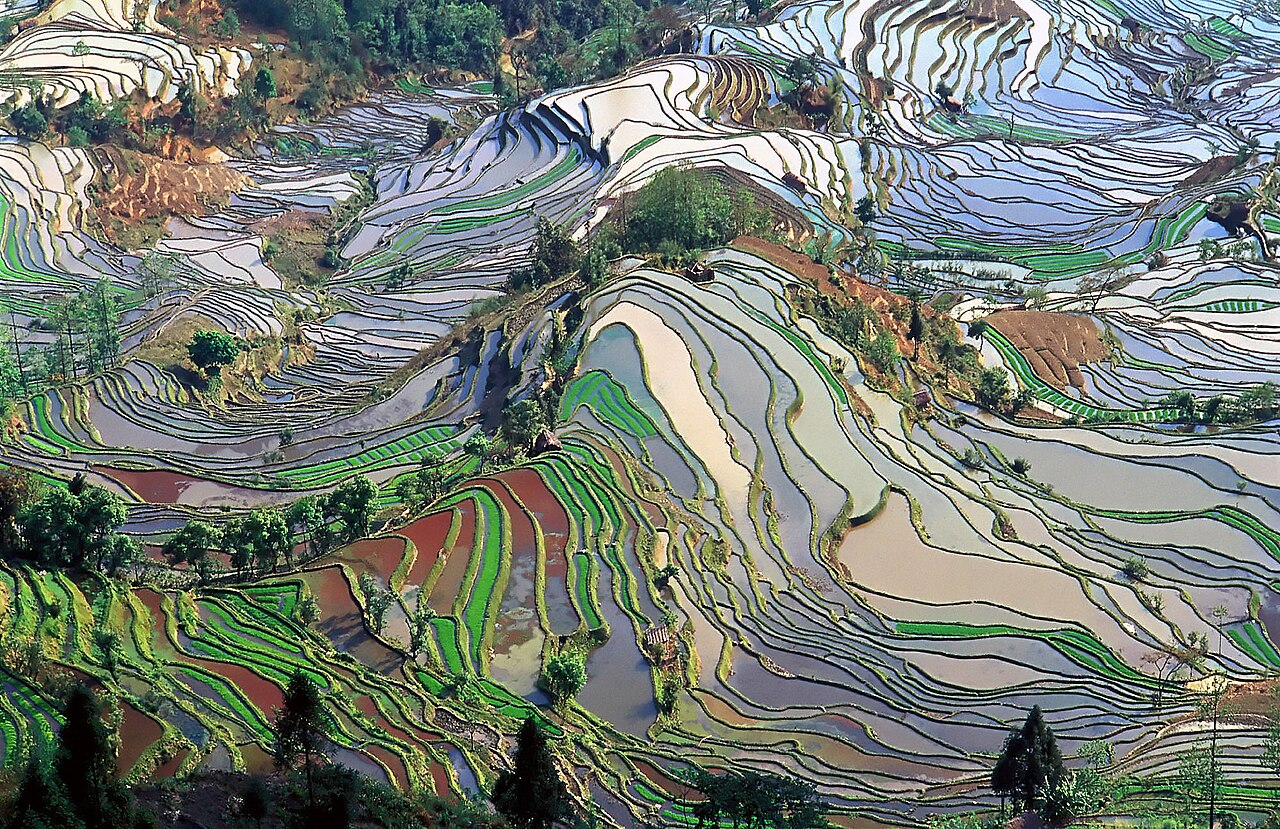
Yunnan, China
Rice-terrace mountains, old Naxi towns, snow peaks and the edge of Tibet.

India
The Taj Mahal, Rajasthan's forts and palaces, holy lakes and the green calm of Kerala.